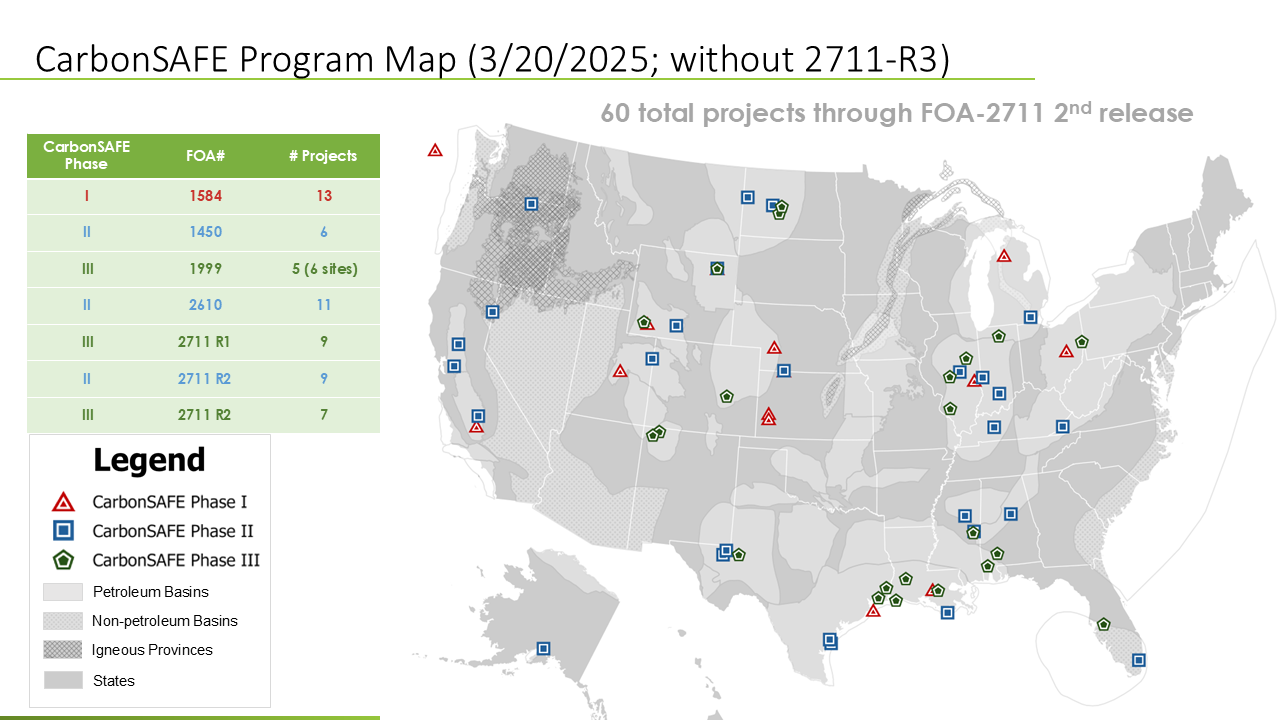
What is CarbonSAFE?
CarbonSAFE (Carbon Storage Assurance Facility Enterprise) is a U.S. Department of Energy (DOE) initiative designed to accelerate the development of safe, commercial-scale carbon dioxide (CO2) storage sites.
The program advances projects in four stages—from early conceptual studies to full construction—to ensure that storage hubs are scientifically sound, technically feasible, economically viable, and socially responsible.
For the Permian Regional Carbon Sequestration Hub (PRCS), CarbonSAFE Phase II focuses on:
Detailed characterization of depleted natural gas reservoirs.
Risk assessments for CO2 capture, transportation, and storage.
Regulatory readiness, including development of Underground Injection Control (UIC) Class VI permit applications.
Community benefits planning, workforce training, and stakeholder engagement.
More information on U.S. DOE CarbonSAFE webpage: LINK
What is CCS?
Carbon Capture Utilization and Storage (CCUS) is a proven technology that reduces CO2 emissions from industrial and energy sources. It allows us to continue using established industries while transitioning to new energy systems. The CCUS process includes:
Capture
Post-combustion capture from power plants.
Industrial process capture (cement, steel, ammonia, biogas, etc.).
Natural gas processing (removing CO2 during production or treatment).
Direct Air Capture (removing CO2 directly from ambient air).
Transportation
- CO2 is compressed into a supercritical fluid.
- Pipelines transport large volumes safely and efficiently.
Storage
- Saline aquifers (mixing with deep brine).
- Depleted oil and gas reservoirs (filling former hydrocarbon space).
- Basalt/mineralization (transforming into stable carbonate rock).
- Enhanced oil recovery (secondary use before permanent storage).